
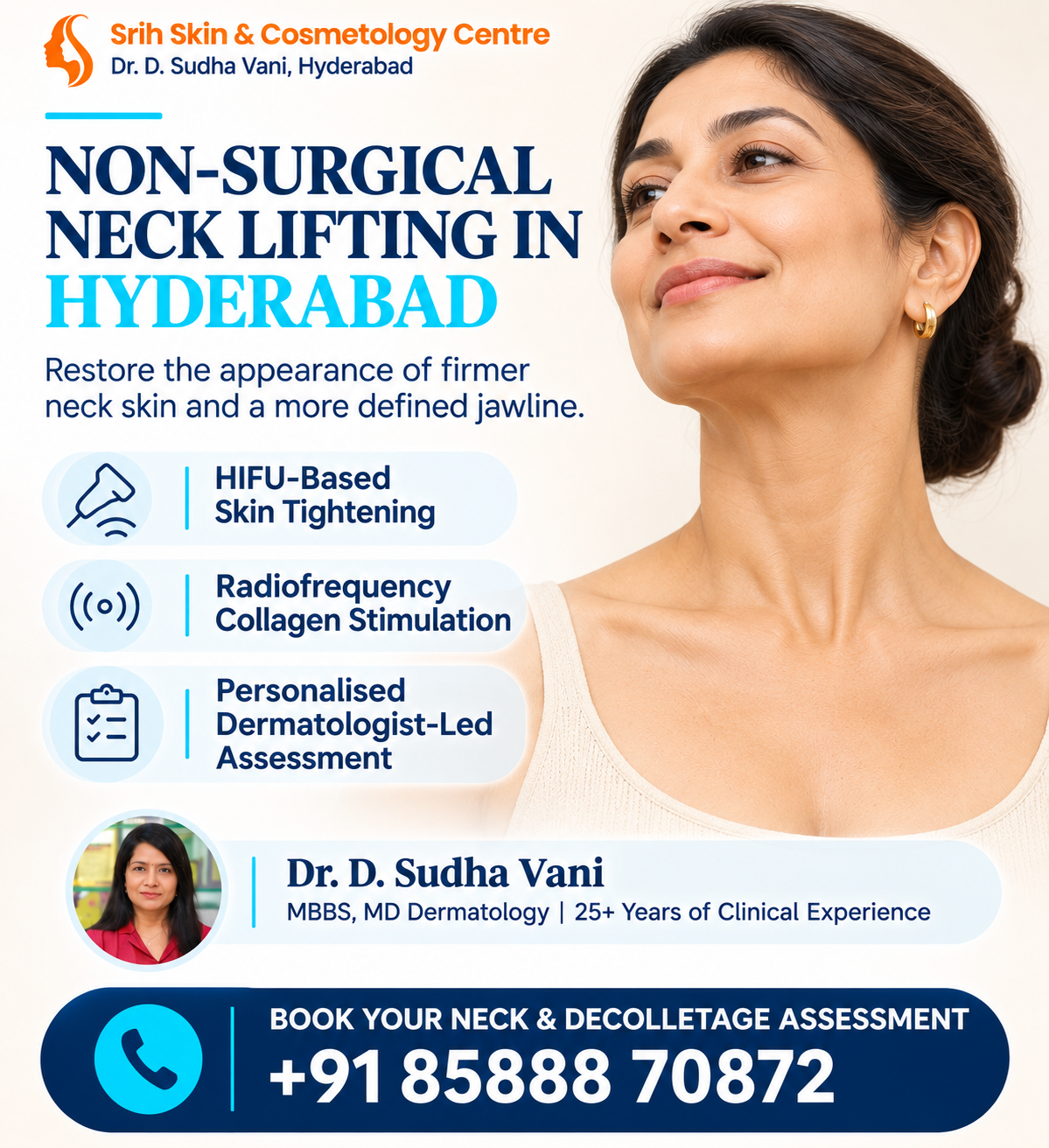
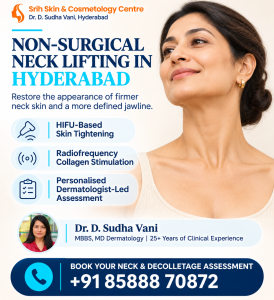
The neck and décolletage are often among the first areas to show visible signs of ageing. Fine horizontal lines, crepey skin, reduced firmness and sagging beneath the chin can gradually affect the definition of the jawline and neck.
At Srih Skin & Cosmetology Centre in Hyderabad, non-surgical neck lifting and skin-tightening treatments are planned according to your skin quality, degree of laxity and underlying anatomy. Depending on clinical suitability and the devices available, treatments such as High-Intensity Focused Ultrasound (HIFU) and Radiofrequency (RF) may be considered to support collagen remodelling and improve the appearance of selected areas.
Under the clinical guidance of Dr. D. Sudha Vani, MBBS, MD Dermatology, with 25+ years of clinical experience, the objective is to identify what is contributing to your neck concerns and recommend an appropriate treatment approach.
Whether you are concerned about loose skin under the chin, horizontal tech-neck lines, early turkey neck changes or wrinkles across the upper chest, a clinical assessment helps determine which treatment options may be suitable.
Quick treatment considerations
Anatomy-led assessment: Evaluation of skin thickness, laxity, fat distribution and visible muscle bands.
Treatment-depth planning: Selection of suitable energy-based technology and settings according to the device and treatment area.
Non-surgical approach: No surgical incision for non-invasive HIFU or RF procedures.
Personalised treatment planning: Neck, jawline and décolletage concerns assessed individually.
Realistic expectations: Results depend on the cause and severity of the concern, the technology used and individual skin response.
Book a Clinical Neck & Decolletage Assessment
Call +91 85888 70872 to enquire about a consultation at Srih Skin Clinic, Banjara Hills or Ameerpet.
1. Why Does Neck and Decolletage Skin Age Faster Than Facial Skin?
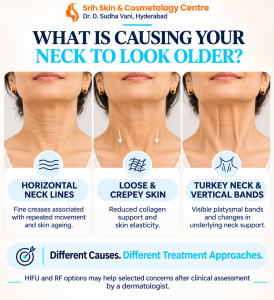
The neck and upper chest have distinct structural and mechanical characteristics. Their skin is exposed to sunlight, repeated movement, changes in posture and the gradual effects of ageing. These factors can contribute to fine lines, reduced elasticity and visible skin laxity.
The skin of the neck is relatively delicate, and its appearance can change noticeably as collagen and elastin decline with age. Repeatedly looking down at mobile phones and other devices may also make horizontal neck creases more noticeable. These are commonly called tech-neck lines.
Three different anatomical factors are particularly important when assessing neck ageing.
1.1 Dermal Collagen and Elasticity Loss
Collagen provides structural support, while elastin helps skin return towards its original shape after movement. With age and cumulative sun exposure, the skin gradually loses some of this support.
Possible visible changes include:
Fine lines and wrinkles.
Thin, crepey or finely folded skin.
Reduced firmness and elasticity.
More noticeable horizontal neck creases.
Wrinkling across the décolletage.
This type of concern is primarily related to skin quality and dermal structure. Treatments that support collagen remodelling may help improve the appearance of selected fine lines and mild skin laxity, although the response varies.
1.2 Subcutaneous Fat and Fullness Beneath the Chin
Fullness below the chin can make the transition between the jawline and neck appear less defined. This may be caused by subcutaneous fat, skin laxity, natural facial structure or a combination of factors.
Common concerns include:
A fuller area beneath the chin.
Reduced jawline definition.
A less distinct chin-to-neck angle.
Loose skin that appears more prominent after weight changes.
It is important to distinguish submental fat from loose skin. A treatment intended to improve skin firmness may not adequately address a significant fat deposit. Likewise, fat-reduction procedures do not necessarily correct skin laxity.
For people whose primary concern is fullness beneath the chin, explore our page on non-surgical double chin removal.
1.3 Platysmal Muscle Bands and Neck Laxity
The platysma is a broad, thin muscle that extends across the front and sides of the neck. As the skin and supporting tissues change with age, vertical bands of this muscle may become more visible.
This can contribute to the appearance commonly described as a turkey neck.
Possible signs include:
Vertical bands along the front of the neck.
Reduced definition between the chin and neck.
Sagging skin beneath the jawline.
A more aged or creased appearance of the lower face and neck.
Prominent platysmal bands are not simply a surface-skin problem. Their treatment may require a different clinical approach from fine wrinkles or mild skin laxity. Non-surgical energy-based procedures should not be presented as equivalent to surgical platysmaplasty.
Understanding the Difference Between Common Neck Concerns
| Concern | Main anatomical factor | Typical visible appearance |
|---|---|---|
| Epidermal and superficial skin changes | Surface skin and its barrier | Fine lines, dryness and roughness |
| Dermal collagen loss | Reduced structural support within the dermis | Crepey skin, fine wrinkles and reduced firmness |
| Submental fullness | Fat beneath the chin | Fuller appearance and reduced jawline definition |
| Platysmal banding | Visible contraction or prominence of the platysma | Vertical neck bands |
| Significant skin redundancy | Excess skin and supporting tissue changes | Pronounced sagging or folds |
Swipe horizontally to view all columns →
Why does this distinction matter?
The right treatment depends on the tissue responsible for the concern. A patient with fine horizontal lines may need a different approach from someone with submental fullness or prominent vertical muscle bands. Treating every neck concern as a single skin-tightening problem can lead to disappointing results.
2. Advanced Energy-Based Treatments for Neck and Décolletage Firming
HIFU and Radiofrequency are energy-based technologies that may be considered for selected patients seeking non-surgical skin tightening. They work through different mechanisms and are not interchangeable.
The treatment plan should account for the device’s specifications, the thickness of the tissue, the location being treated and the safety limitations of the cervical region.
2.1 HIFU: Focused Ultrasound for Selected Deeper Tissue Tightening
High-Intensity Focused Ultrasound uses focused acoustic energy to create controlled thermal effects at selected tissue depths. Depending on the device and its approved indications, this may stimulate a wound-healing response and subsequent collagen remodelling.
Potential treatment objectives include:
Improving the appearance of mild-to-moderate skin laxity.
Supporting firmness in appropriately selected areas.
Improving the appearance of selected jawline and lower-face concerns.
Providing a non-surgical option for patients who are not suitable for or do not want surgery.
Understanding HIFU Treatment Depths
Some HIFU platforms offer transducers with nominal focal depths such as 1.5 mm, 3.0 mm and 4.5 mm. These measurements describe device-specific focal depths; they do not automatically identify the same anatomical structure in every patient.
For example:
Superficial settings: May be designed to target relatively superficial tissue layers, depending on the platform.
Intermediate settings: May target deeper dermal or subdermal tissue, depending on the patient’s anatomy and the device.
Deeper settings: May be intended for deeper supportive tissue in approved treatment areas.
A 4.5 mm transducer should not automatically be described as reaching the SMAS or contracting the platysma in every neck. Actual tissue depth varies, and the neck has important anatomical structures that require careful consideration.
Important: HIFU is not suitable for every neck concern. Prominent platysmal bands, significant excess skin and certain anatomical or medical conditions may require other treatments or surgical assessment.
2.2 Radiofrequency: Dermal Heating and Collagen Remodelling
Radiofrequency technology uses electrical energy to produce controlled heating within targeted tissue. Depending on the device, treatment parameters and delivery method, this may stimulate collagen remodelling and improve the appearance of selected skin-quality concerns.
Potential treatment objectives include:
Improving the appearance of fine lines.
Supporting skin firmness.
Addressing mild crepey skin.
Improving the appearance of selected horizontal neck creases.
Supporting skin quality across the décolletage.
Some RF platforms are designed to deliver energy at superficial or mid-dermal depths. However, treatment depth and thermal distribution depend on the specific device, applicator, technique and settings.
RF should not be described as automatically treating all horizontal neck lines. Established folds may have several contributing factors, including repeated movement, skin ageing and underlying anatomical structure.
2.3 Why a Multi-Layer Treatment Assessment Matters
Neck ageing is rarely caused by one factor alone. A patient may have fine surface lines, reduced dermal firmness and some fullness below the chin at the same time.
A multi-layer assessment helps determine whether one treatment modality or a combination may be appropriate.
| Tissue or concern | Possible treatment consideration | Important limitation |
|---|---|---|
| Superficial skin texture | Appropriate skin-care or surface-level procedures | Does not correct deeper laxity |
| Dermal collagen loss | Selected RF or other collagen-stimulating treatments | Results vary with device and skin condition |
| Mild deeper tissue laxity | Selected HIFU treatment | Requires suitable anatomy and device-specific planning |
| Submental fat | Assessment for an appropriate fat-reduction approach | Skin tightening alone may not reduce fat |
| Prominent platysmal bands | Specialist assessment, including surgical options where appropriate | HIFU and RF cannot be assumed to correct muscle bands |
| Significant excess skin | Surgical neck-lift assessment may be appropriate | Non-surgical treatments cannot remove substantial excess skin |
The aim is not to use every available technology. It is to identify the tissue responsible for the concern and select a treatment that has a reasonable chance of improving it.
For a broader understanding of HIFU treatment in Hyderabad, read our dedicated treatment guide.
3. Surgical Neck Lift vs. Non-Surgical HIFU and RF Neck Tightening
Patients considering neck lifting often want to understand whether a non-surgical treatment can provide results comparable to surgery.
The answer depends on the degree of skin laxity, the presence of platysmal bands, the amount of excess tissue and the individual’s expectations.
| Criteria | Non-Surgical HIFU and RF Neck Tightening | Surgical Neck Lift (Including Platysmaplasty) |
|---|---|---|
| Procedure approach | Uses energy-based technology to create controlled tissue heating and support collagen remodelling. | Surgically addresses selected excess skin, fat and/or platysmal muscle concerns. |
| Anaesthesia and invasiveness | Usually performed without general anaesthesia when using non-invasive devices; sensation and comfort vary. | Requires anaesthesia and a surgical procedure. |
| Scarring risk | No surgical incision or planned surgical scar with non-invasive treatment. | Incisions and scars are expected, although placement varies. |
| Recovery downtime | Usually limited; temporary redness, swelling, tenderness or other side effects may occur. | Longer recovery, with post-operative care and activity restrictions. |
| Ideal candidate | Selected patients with mild-to-moderate laxity and realistic expectations. | Patients with significant skin redundancy, prominent muscle bands or more advanced neck ageing. |
Swipe horizontally to compare both treatment options →
When May Non-Surgical Neck Tightening Be Suitable?
A dermatologist may consider non-surgical treatment when a patient has:
Mild-to-moderate neck skin laxity.
Early loss of firmness.
Fine lines or crepey skin.
Selected lower-face and jawline laxity.
A preference for avoiding surgery.
Realistic expectations about gradual and potentially modest improvement.
When Might Surgery Be More Appropriate?
A surgical consultation may be more suitable when there is:
Significant loose or hanging skin.
Pronounced vertical platysmal bands.
Marked loss of the chin-to-neck angle.
Substantial excess tissue.
A need for more structural correction than energy-based treatment can reasonably provide.
A non-surgical treatment should not be recommended simply because a patient wants to avoid surgery. The expected benefit must be weighed against the severity of the concern.
4. Your Clinical Consultation and Neck Tightening Treatment Journey
A neck-tightening plan should begin with an assessment rather than an automatic recommendation for a particular device or treatment depth.
At Srih Skin & Cosmetology Centre, the consultation process should focus on understanding the patient’s anatomy, skin condition, medical history and treatment expectations.
Step 1: Clinical Assessment and Anatomical Mapping
Dr. D. Sudha Vani assesses the neck, jawline and décolletage to identify the main contributors to the visible concern.
The assessment may include:
Skin thickness, texture and elasticity.
The degree and distribution of skin laxity.
Submental fat fullness.
Visible platysmal bands.
Horizontal lines and folds.
Previous aesthetic procedures and relevant medical history.
The front and sides of the neck contain important structures, including the thyroid gland, thyroid cartilage, laryngeal and tracheal structures, and carotid neurovascular bundles. Treatment planning must account for these structures and the specific device’s approved treatment boundaries.
Why is specialist assessment important?
Energy-based treatments should not be applied indiscriminately across the front of the neck. A qualified medical professional must understand the relevant anatomy, assess contraindications and determine whether the proposed treatment is appropriate. Specific treatment zones and exclusions depend on the device instructions and clinical judgement.
Step 2: Selecting the Appropriate Treatment and Depth
The choice of technology depends on the tissue being treated and the device being used.
The clinician considers:
Whether the concern is primarily superficial or dermal.
Whether there is deeper tissue laxity.
Whether submental fat is contributing to the appearance.
Whether the proposed HIFU or RF platform is suitable for the neck or décolletage.
The device-specific applicators, energy settings and safety instructions.
Nominal depths such as 1.5 mm, 3.0 mm and 4.5 mm should only be used when supported by the actual device and appropriate for the treatment area. They are not universal prescriptions.
Step 3: The In-Clinic Procedure
If a non-invasive HIFU or RF procedure is considered suitable, the treatment area is prepared according to the device protocol.
The procedure may involve:
Cleansing and preparing the treatment area.
Marking the intended treatment zones.
Applying the appropriate device applicator and coupling medium, where required.
Delivering controlled energy according to the treatment plan.
Monitoring comfort and skin response.
Providing aftercare instructions.
The duration depends on the treatment area, device and number of planned treatment points. Some sessions may take approximately 30–45 minutes, but this should not be treated as a guaranteed duration for every patient.
Step 4: Understanding the Results Timeline
Collagen remodelling is a gradual biological process. Improvement is not necessarily visible immediately after treatment.
Patients may notice:
Immediately after treatment: Temporary redness, tenderness or swelling may occur. Any immediate sensation of tightness does not represent the final result.
Over the following weeks: The tissue response and collagen remodelling process continue.
Around 8–12 weeks: Some patients may begin to assess the developing outcome, depending on the technology and treatment.
Beyond three months: The degree of improvement and its duration vary according to age, skin quality, treatment type and individual response.
A follow-up assessment can help determine whether the outcome is satisfactory or whether another treatment approach should be considered.
5. Neck Tightening Treatment Cost in Hyderabad
The cost of neck tightening treatment in Hyderabad depends on the treatment area, the technology used and the degree of correction required.
There is no single price that applies to every patient. A person seeking improvement in fine neck lines may require a different treatment plan from someone with loose skin beneath the chin and reduced jawline definition.
Factors That Influence Neck Tightening Cost
1. Treatment Area
The treatment plan may cover:
Neck only.
Neck and jawline.
Neck and décolletage.
A combined neck, lower-face and décolletage plan.
A larger treatment area may require more time and treatment points.
2. Degree of Skin Laxity
Mild crepiness and early loss of firmness are different from pronounced skin redundancy or visible platysmal bands. The severity of the concern influences the type of treatment that may be appropriate.
3. Technology and Device
Different HIFU and RF platforms have different applicators, treatment protocols and operating costs. The number of treatment points or ultrasound lines may also influence the overall cost where relevant.
4. Combination Treatment Recommendations
Some patients may be assessed for a combination of technologies. However, combining HIFU and RF is not automatically necessary or more effective. The recommendation should be based on clinical suitability and the expected benefit of each treatment.
5. Medical Assessment and Follow-Up
A responsible treatment plan includes an assessment of suitability, discussion of potential risks, realistic expectations and appropriate follow-up.
Why Should You Avoid Choosing a Neck Treatment on Price Alone?
The neck is an anatomically sensitive region. Treatment requires knowledge of the underlying structures, an appropriate device and careful selection of treatment settings.
An unusually low-cost offer does not necessarily provide the same device, clinical assessment, treatment protocol or follow-up as a physician-led procedure.
When comparing providers, consider:
Who performs the assessment and treatment.
Whether the device is appropriate for the intended area.
Whether the provider explains the limitations and possible complications.
Whether the treatment is performed according to the manufacturer’s instructions.
Whether there is a clear plan for follow-up and managing adverse effects.
For an accurate estimate, book a clinical assessment. The recommended treatment and cost can be discussed after evaluating your neck and décolletage concerns.
Frequently Asked Questions About Non-Surgical Neck Lifting
HIFU may improve the appearance of mild-to-moderate skin laxity in appropriately selected patients. However, it cannot reliably remove substantial excess skin or correct pronounced platysmal bands. Patients with severe turkey neck changes may need a surgical neck-lift assessment to understand the options for more significant correction.
There is no fixed number of HIFU sessions for horizontal neck lines. The appropriate approach depends on the cause of the lines, skin quality, device and treatment indication. Some horizontal lines are related to repeated neck movement and established skin folds rather than deeper tissue laxity. RF or other skin-quality treatments may be considered in selected cases. A clinical assessment is necessary before recommending a session plan.
Comfort varies according to the technology, treatment settings, individual sensitivity and treatment area. HIFU may produce brief sensations of heat, tingling or discomfort, while RF may create a warming sensation. The front of the neck and areas near important anatomical structures require particular care. Treatment should only be performed within the device’s approved indications and safety boundaries by an appropriately qualified provider.
The duration of improvement varies between individuals. It depends on the device, treatment response, age, skin quality, degree of laxity and ongoing ageing. HIFU results are not permanent, and the skin continues to age after treatment. Your clinician can discuss realistic expectations and whether follow-up treatment may be appropriate.
In selected patients, neck skin tightening and treatment for submental fullness may be considered as part of a broader lower-face and neck plan. However, skin laxity and submental fat are different concerns and may require different treatment approaches. The suitability, sequence and safety of any combination must be assessed individually. Read more about non-surgical double chin removal.
RF may help improve the appearance of selected fine lines and crepey skin by producing controlled tissue heating and supporting collagen remodelling. However, established horizontal folds may not disappear completely, and results depend on the device, treatment method and cause of the lines.
No. Suitability depends on skin condition, anatomy, medical history, the device being used and the concern being treated. A clinician should review relevant medical conditions, medications, previous procedures and contraindications before recommending treatment.
Non-invasive HIFU and RF generally involve less downtime than surgery. However, temporary redness, swelling, tenderness, bruising or other adverse effects can occur. Recovery varies by device and individual response. Patients should follow the aftercare advice provided by their treating clinician.
7. Book a Neck and Décolletage Assessment in Hyderabad
Neck ageing can involve several different structures, from superficial skin changes to deeper tissue laxity and visible platysmal bands. Identifying the cause is the first step towards choosing an appropriate treatment.
At Srih Skin & Cosmetology Centre, Dr. D. Sudha Vani brings over 25 years of clinical experience in dermatology and aesthetic care to the assessment of skin and ageing concerns.
If you are considering non-surgical neck lifting, HIFU neck tightening, treatment for loose skin under the chin or improvement in décolletage skin quality, book a consultation to discuss your options.
Book a Clinical Neck & Decolletage Assessment
Call: +91 85888 70872
Email: ssccclinic@gmail.com
Visit Srih Skin & Cosmetology Centre
Banjara Hills Branch
286/A, Second Floor, Sri Mahaan Heights,
Mathur Road, Road No. 92,
Banjara Hills, Hyderabad, Telangana – 500096.
Ameerpet Branch
135, Rahmat Complex, Ameerpet Road,
Opposite Elephant House Complex,
Ameerpet, Hyderabad, Telangana – 500016.
Speak to the clinic to enquire about consultation availability and suitable treatment options.
Explore More Treatments at Srih Skin Clinic
If you are researching other non-surgical skin-tightening and body-contouring options, these guides may also help:
HIFU treatment in Hyderabad – Learn about focused ultrasound treatment and its potential applications.
Non-surgical double chin removal – Understand the different causes of fullness beneath the chin.
Non-invasive body sculpting and cryolipolysis – Compare technologies used for selected body-contouring concerns.
Non-surgical arm lift – Explore options for upper-arm skin laxity and contouring.
Dermatologist-led body contouring – Understand why clinical assessment matters when choosing energy-based treatments.
Medical Disclaimer
The information on this page is intended for general educational purposes and does not replace an individual medical consultation. HIFU, Radiofrequency and other aesthetic procedures may not be suitable for everyone, and outcomes vary between individuals.
Treatment selection, device settings and expected results must be determined by a qualified medical professional after an appropriate assessment. Non-surgical treatments cannot guarantee surgical-equivalent results and may not adequately address severe skin laxity, significant excess skin or prominent platysmal bands.
All procedures carry potential risks and side effects. Patients should discuss suitability, contraindications, alternatives, expected outcomes and possible complications with their treating clinician before proceeding.