
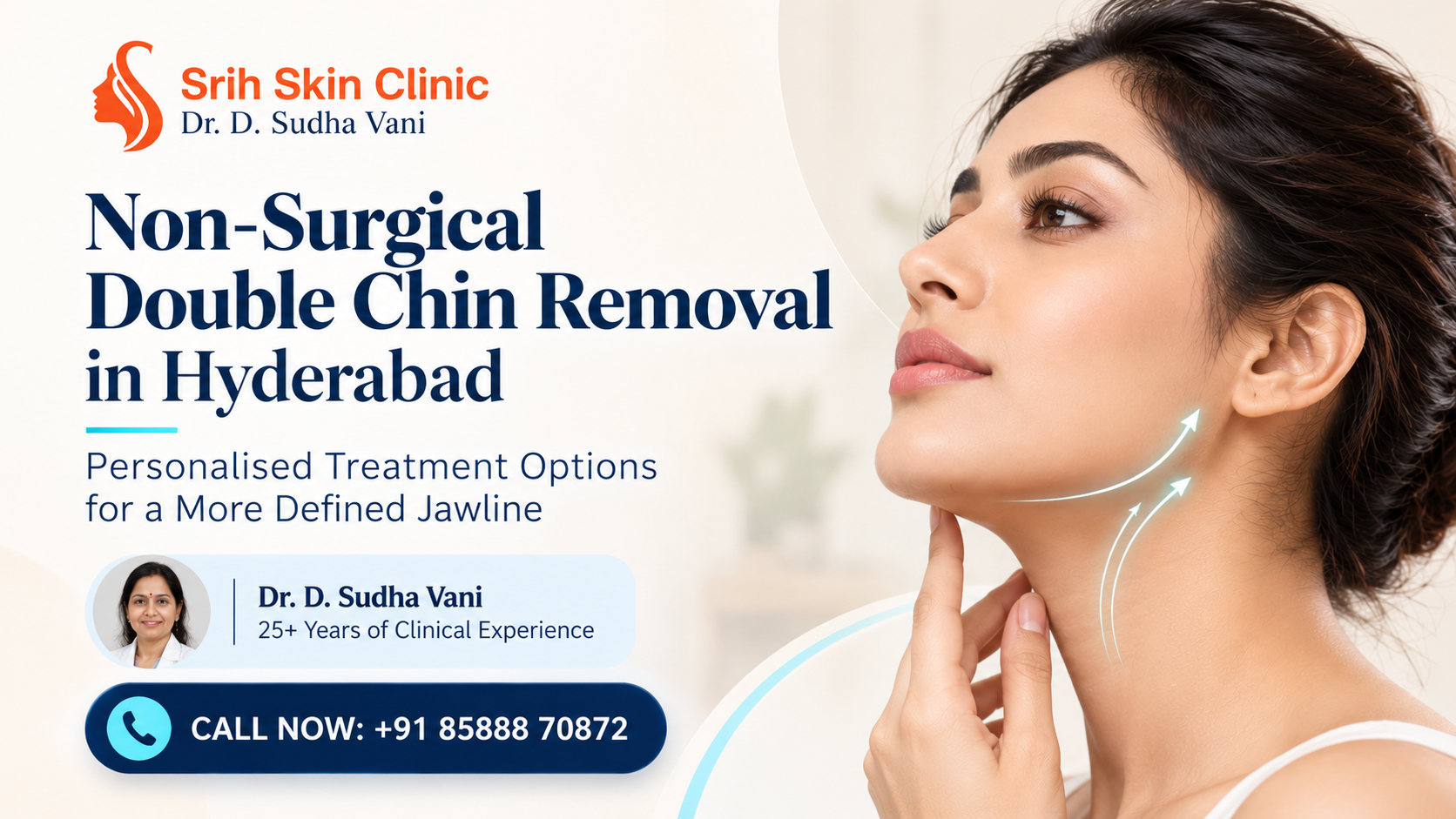
A double chin can develop because of localised fat beneath the chin, loose skin, ageing or natural facial anatomy. Non-surgical double chin reduction in Hyderabad starts with identifying the underlying cause so the treatment can be matched to your skin, submental fat and jawline structure.
At Srih Skin & Cosmetology Centre, Dr. D. Sudha Vani brings over 25 years of clinical experience to dermatology and aesthetic care. Patients seeking a more defined jawline can discuss appropriate treatment options following an individual clinical assessment.

The objective is to improve facial contour where possible without promising unrealistic or uniform results.
What to know before choosing a treatment:
Treatment areas: Double chin, loose skin under the chin and selected jawline concerns.
Treatment options: HIFU, cryolipolysis or injection lipolysis may be considered where clinically appropriate and available.
Downtime: Varies by procedure; non-surgical does not mean completely risk-free or recovery-free.
Personalised planning: Treatment depends on whether excess fat, skin laxity or anatomical factors are responsible.
Clinic locations: Banjara Hills and Ameerpet, Hyderabad.
Book a Clinical Assessment
Call Srih Skin Clinic at +91 85888 70872 to discuss your double chin and jawline concerns.

Understanding Double Chin: Why One Treatment Does Not Fit All
A double chin can result from excess submental fat, loose skin or the natural structure of the chin, jaw and neck.
Understanding the cause helps determine whether a fat-reduction procedure, skin-tightening treatment or a different clinical approach is appropriate.
1. Skin Laxity and Ageing
Loose skin beneath the chin can make the jawline appear less defined, even when there is little excess fat.
Ageing: Changes in skin elasticity and supporting tissues can contribute to sagging.
Weight changes: Skin may remain loose after weight loss.
Jawline definition: Reduced skin firmness can soften the transition between the chin and neck.
Treatment consideration: Selected skin-tightening procedures may help improve the appearance of mild laxity.
When loose skin is the primary concern, removing fat alone may not deliver the desired contour and can sometimes make laxity more noticeable.
2. Localised Submental Fat
Submental fat is the fat deposit beneath the chin that can create a rounded or fuller appearance.
Localised fat: A small fat pad may persist despite a stable weight.
Genetics: Family traits can influence fat distribution.
Body composition: A double chin can occur in people across different body sizes.
Treatment consideration: Selected patients may be candidates for fat freezing, appropriate fat-dissolving injections or other fat-reduction procedures.
A clinical assessment helps establish whether the fullness is actually caused by submental fat rather than loose skin or another anatomical feature.
3. Structural Anatomy and Genetics
The shape of the chin, jawbone, neck muscles and other underlying structures can influence how prominent a double chin appears.
Chin projection: A less prominent chin can affect the visible chin-to-neck angle.
Jaw structure: Natural bone structure influences facial definition.
Muscle anatomy: Neck muscle contours can contribute to the appearance of the lower face.
Genetic traits: Inherited facial characteristics can affect the submental profile.
Treatment consideration: Fat reduction or skin tightening may have limited benefit when anatomy is the main cause.
Why Is Clinical Assessment Better Than Generic Slimming Treatments?
Effective double chin treatment requires identifying the tissue responsible for the concern rather than assuming every patient needs fat reduction.
Cause-based selection: Match the procedure to fat, skin laxity or anatomy.
Appropriate technology: Confirm that the selected device is suitable for the intended treatment area.
Safety screening: Review relevant medical history, previous procedures and possible contraindications.
Realistic expectations: Understand what the selected procedure can and cannot change.
Massagers, slimming pads and salon treatments should not be assumed to produce lasting fat reduction or clinically meaningful skin tightening. Treatment claims should be supported by the technology used and appropriate clinical evidence.

Non-Surgical Double Chin Removal Treatments
The appropriate non-surgical double chin treatment depends on the amount of submental fat, the degree of skin laxity and the patient’s individual suitability.
The following options use different mechanisms and are not interchangeable. Their availability at Srih Skin Clinic should be confirmed when booking.
1. HIFU for Double Chin
HIFU uses focused ultrasound energy and may be considered for selected skin-tightening or contouring concerns, depending on the device and its intended use.
HIFU stands for high-intensity focused ultrasound. Certain aesthetic ultrasound systems deliver focused energy at selected tissue depths to produce controlled thermal effects.
Best considered for: Selected patients with mild skin laxity and suitable contouring goals.
Mechanism: Focused ultrasound energy produces controlled thermal effects in targeted tissue.
Jawline appearance: May improve the appearance of laxity in appropriately selected patients.
Treatment planning: Depends on device specifications, anatomical assessment and the treatment indication.
Limitations: HIFU is not a guaranteed fat-removal procedure and may not adequately address a substantial fat pad or significant loose skin.
The SMAS is a deeper supporting tissue layer relevant to certain facial aesthetic procedures. However, the depth reached by HIFU varies by device and treatment cartridge. A treatment should not be described as targeting the SMAS unless the specific device and protocol support that claim.
Is HIFU suitable for loose skin under the chin?
HIFU may be an option when skin laxity is an important part of the concern. The likely benefit depends on the degree of laxity, anatomy and the technology used.
For more information, see our HIFU treatment in Hyderabad page.
2. Cryolipolysis or Fat Freezing for Double Chin
Cryolipolysis uses controlled cooling to target selected localised fat deposits in appropriately designed treatment systems.
The technology is intended to affect fat cells in the treated area. The body subsequently processes the affected cells over time.
Best considered for: Selected patients with a localised, treatable fat deposit beneath the chin.
Mechanism: Controlled cooling affects targeted fat cells.
Treatment planning: Depends on the device, applicator suitability and thickness of the fat deposit.
Expected changes: Results develop over time and vary between patients.
Limitations: Fat freezing does not directly correct significant loose skin and is not a weight-loss treatment.
Not every fat-freezing device is suitable for the submental area. The clinic should confirm that the specific system is designed and appropriate for this treatment site.
3. Double Chin Injection Lipolysis
Injection lipolysis uses injected substances intended to reduce localised fat, but the product, evidence, regulatory status and risks must be assessed carefully.
Deoxycholic acid is an example of an active ingredient used in a prescription injectable specifically indicated for submental fat reduction in certain jurisdictions. Other products marketed as fat-dissolving injections may have different ingredients, evidence and regulatory status.
Best considered for: Selected adults with localised submental fat and suitable skin quality.
Mechanism: Certain agents disrupt fat-cell membranes.
Treatment planning: Requires precise anatomical assessment and administration by a suitably qualified medical professional.
Possible effects: Swelling, pain, bruising, numbness and firmness or nodules may occur.
Limitations: These injections do not reliably correct significant skin laxity and are not appropriate for every patient.
Injection lipolysis should never be treated as a routine salon procedure. Deoxycholic acid injections have important risks, including nerve injury, swallowing difficulties, tissue damage and persistent injection-site nodules or masses. Product-specific prescribing information and applicable Indian regulatory requirements must be followed. FDA safety information.
4. Surgical Liposuction
Submental liposuction is a surgical option that removes selected fat deposits through a procedure performed by an appropriately qualified surgeon.
Best considered for: Suitable patients with localised fat who want a surgical approach.
Mechanism: Fat is physically removed from the treated area.
Anaesthesia and recovery: Depend on the surgical plan and individual circumstances.
Limitations: Surgery has procedural risks and does not automatically correct significant skin laxity.
Liposuction may be considered when non-surgical approaches are unlikely to achieve the desired degree of fat reduction. A surgical assessment is needed to determine suitability.
HIFU vs Fat Freezing vs Double Chin Injections
HIFU, cryolipolysis and injection lipolysis address different tissue concerns, so the best option depends on the cause of the double chin.
| Criteria | HIFU | Cryolipolysis | Injection lipolysis | Surgical liposuction |
|---|---|---|---|---|
| Main target | Selected skin-tightening and contouring concerns | Localised fat | Localised fat | Localised fat |
| Mechanism | Focused ultrasound energy | Controlled cooling | Injectable agent affecting fat cells | Surgical fat removal |
| Best candidate | Selected patients with appropriate laxity or contour concerns | Patients with a suitable localised fat deposit | Patients with suitable submental fat and anatomy | Suitable surgical candidates |
| Downtime | Usually limited, but treatment effects can occur | Usually limited, but tenderness or swelling can occur | Swelling, bruising and discomfort can be more noticeable | Generally greater recovery requirements |
| Primary benefit | Potential improvement in selected laxity concerns | Gradual reduction in selected fat deposits | Gradual reduction in selected submental fat | More direct removal of localised fat |
| Key limitation | Not a guaranteed solution for substantial fat or severe laxity | Does not directly correct significant loose skin | Product-specific risks; not suitable for everyone | Invasive procedure with surgical risks |
Non-surgical procedures may offer selected patients an alternative to surgery, but they do not reproduce every result achievable through surgical intervention.
What to Expect During Your Double Chin Consultation
A clinical consultation establishes the cause of your double chin, reviews treatment suitability and identifies realistic options before any procedure is recommended.
Step 1: Clinical Assessment and Submental Mapping
The clinician examines the chin and neck to assess fat distribution, skin laxity and relevant anatomical features.
Visual assessment: Review the chin-to-neck profile and jawline.
Palpation: Assess the submental tissue where appropriate.
Skin quality: Examine the degree of laxity.
Medical history: Discuss health conditions, medications and previous aesthetic procedures.
Other causes: Consider whether the fullness could have a cause other than localised fat.
Step 2: Personalised Treatment Plan
The recommended treatment should match the cause of the concern and the patient’s medical suitability.
Skin laxity: Consider appropriate tightening options.
Localised fat: Evaluate suitable fat-reduction procedures.
Mixed concerns: Discuss whether one procedure or a staged approach is appropriate.
Anatomical factors: Explain when non-surgical treatment may have limited benefit.
Cost and risks: Review expected expenses, side effects and alternatives before consent.
Step 3: In-Clinic Treatment
The treatment session follows the selected device or procedure protocol after the patient has been assessed and informed about the risks.
Preparation: Review the treatment area and obtain informed consent.
Procedure: Deliver the selected treatment according to its protocol.
Monitoring: Check the treated area and address immediate concerns.
Aftercare: Provide instructions specific to the procedure.
Step 4: Follow-Up and Results
Double chin treatment results develop at different rates depending on the procedure and the individual’s response.
HIFU: Tightening effects may develop progressively.
Fat freezing: Changes in the treated fat can take weeks to months.
Injection lipolysis: Swelling may initially obscure changes, and multiple sessions may be required.
Review: Follow-up helps assess the response and determine whether further treatment is appropriate.
An 8–12 week review may be useful for some treatment plans, but it is not a universal deadline for final results. The follow-up schedule should match the procedure performed.
Double Chin Removal Treatment Cost in Hyderabad
Double chin removal treatment cost in Hyderabad depends on the procedure selected, the size of the treatment area, the degree of fat or skin laxity and the number of sessions required.
| Cost factor | How it affects pricing |
|---|---|
| Treatment type | HIFU, cryolipolysis, injections and surgery have different cost structures |
| Treatment area | The size and complexity of the area influence planning |
| Number of sessions | Some treatments require more than one session |
| Degree of concern | The extent of fat and skin laxity affects treatment selection |
| Combination procedures | Additional procedures may increase the total cost |
| Follow-up and aftercare | Inclusions vary between providers |
How to Compare Double Chin Treatment Prices
Compare the treatment, clinical supervision, device suitability and aftercare rather than choosing solely by the lowest advertised price.
Technology: Ask which device or product will be used.
Provider qualifications: Confirm who will assess and perform the procedure.
Treatment plan: Clarify the number of sessions and areas included.
Safety: Ask about potential side effects and complication management.
Transparency: Request a written estimate covering the planned treatment and follow-up.
There is no single price that applies to every double chin. Srih Skin Clinic can discuss the appropriate treatment options and provide a personalised quotation after assessment.
Book a Clinical Assessment for Double Chin Reduction
Call +91 85888 70872 to enquire about consultation availability and treatment pricing.
Why Choose Dr. Sudha Vani and Srih Skin Clinic?
Srih Skin & Cosmetology Centre provides dermatology and aesthetic care under the leadership of Dr. D. Sudha Vani, with clinics in Banjara Hills and Ameerpet.
Clinical experience: Dr. Sudha Vani has over 25 years of clinical experience, according to the clinic’s supplied information.
Dermatology background: Her qualifications include MBBS and MD in Dermatology.
Personalised care: Treatment planning should reflect the patient’s anatomy, skin condition and goals.
Established practice: The clinic states that it has provided skin and cosmetic treatments since 2003.
Two Hyderabad locations: Patients can enquire about appointments at Banjara Hills or Ameerpet.
Treatment transparency: Appropriate counselling should include risks, limitations, alternatives and expected costs.
The clinic’s approach should prioritise suitability and informed decision-making rather than recommending the same procedure to every patient.