
Concerned about loose upper arms, stubborn arm fat or the appearance commonly described as “bat wings”?
Changes in the upper arms can occur due to ageing, weight fluctuations, reduced skin elasticity and localised fat accumulation. Even with regular exercise and a healthy lifestyle, some people continue to notice loose skin or fullness around the back and inner portions of their upper arms.
If you are exploring a non-surgical arm lift in Hyderabad, it is important to understand what is causing the change in your arm contour. Excess fat, reduced skin firmness and changes in muscle definition are different concerns and may require different treatment approaches.
At Srih Skin & Cosmetology Centre, Dr. D. Sudha Vani, M.D. Dermatology, brings over 25 years of clinical experience in dermatology and aesthetic care. An individual assessment can help determine whether HIFU, radiofrequency (RF), another treatment approach or surgical consultation may be more appropriate.
Areas and concerns that may be assessed
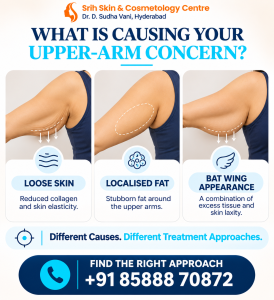
Loose skin around the upper arms.
Localised fat deposits along the inner arms.
Sagging skin around the triceps area.
Crepey or reduced skin firmness.
Upper-arm contour changes following weight loss.
Treatment approach: HIFU and RF may be considered for selected skin-tightening concerns, depending on the device and clinical assessment.
Clinical assessment: Individual evaluation of skin elasticity, fat distribution and treatment suitability.
Recovery: Non-surgical procedures generally avoid surgical incisions, although temporary side effects and recovery considerations remain possible.
Book an Arm Contouring Assessment with Dr. Sudha Vani.
Call: +91 85888 70872
1. Understanding Bat Wings and Loose Upper Arm Skin
The term “bat wings” commonly describes loose or hanging tissue beneath the upper arms, particularly around the triceps area.
It may become more noticeable when raising the arms, stretching them sideways or wearing sleeveless clothing.
However, not every case of upper-arm fullness has the same cause. Understanding the underlying concern is essential before choosing an arm fat reduction treatment.
1. Loss of Dermal Elasticity
The skin naturally changes with age. Collagen and elastin, which contribute to its structure and elasticity, gradually decline.
This may result in:
Reduced skin firmness.
Fine wrinkles and crepey texture.
Loose skin around the inner upper arms.
Less defined arm contours.
Sun exposure, genetics and individual skin characteristics may also influence skin quality.
When reduced elasticity is the primary concern, simply reducing fat may not provide the desired appearance.
2. Localised Subcutaneous Fat Accumulation
Subcutaneous fat is located directly beneath the skin.
Some individuals develop localised fat deposits around the upper arms, even when their overall body weight is relatively stable.
This may create a fuller appearance around the inner arm and triceps region.
If excess fat is the main concern, treatment discussions may include appropriate fat-reduction options. Skin tightening alone may not substantially reduce a prominent fat deposit.
3. Weight Fluctuations and Post-Weight-Loss Skin Laxity
Significant weight gain followed by weight loss can stretch the skin.
After substantial weight reduction, some individuals may have excess skin that does not fully retract.
This can be particularly noticeable around the upper arms following major weight loss or bariatric surgery.
The degree of loose skin matters when selecting treatment.
Mild laxity may be assessed for suitable non-surgical tightening procedures.
Moderate laxity may require a more detailed discussion of expected improvement and limitations.
Significant excess skin may respond more predictably to surgical arm lifting.
4. Reduced Muscle Definition
The triceps muscles contribute to the shape of the back of the upper arm.
Reduced muscle definition can influence the overall appearance of the arm, although it is not the same as loose skin or excess fat.
Strength training may help improve muscle tone and definition. However, exercise cannot directly remove excess skin or selectively burn fat from one particular arm area.
Why diagnosis matters: A person with excess fat, another with loose skin and someone with limited muscle definition may all describe their concern as “bat wings”. Their treatment requirements can be very different.
2. The Dual-Technology Approach: HIFU and Radiofrequency for Arm Tightening
HIFU and radiofrequency are two different energy-based technologies used in selected aesthetic skin-tightening applications.
They work through different mechanisms and should not be treated as interchangeable procedures.
For appropriate patients, a clinician may consider one technology or a combination depending on the degree of skin laxity, tissue characteristics and the capabilities of the available device.
1. HIFU: Focused Ultrasound for Deeper Tissue Tightening
High-Intensity Focused Ultrasound (HIFU) delivers focused ultrasound energy to selected tissue depths.
The energy produces controlled thermal effects at targeted focal points. Depending on the device, treatment settings and indication, these effects may support tissue remodelling and collagen-related responses.
For selected body applications, some systems offer deeper transducers designed for particular tissue targets.
Potential treatment goals:
Improving the appearance of selected skin-laxity concerns.
Supporting a firmer-looking upper-arm contour.
Addressing suitable areas of reduced skin firmness.
What about 6 mm and 9 mm HIFU cartridges?
Some body-focused ultrasound systems offer transducers with nominal focal depths such as 6 mm or 9 mm.
These specifications describe the device’s intended focal depth. They do not automatically establish that the energy reaches a particular anatomical structure or destroys fat cells in every patient.
The actual target depends on:
Device design and manufacturer specifications.
Tissue thickness.
Fat distribution.
Treatment area.
Applicator suitability.
Individual anatomy.
A clinician should verify whether the particular HIFU system is appropriate for upper-arm treatment and what outcome it is designed to achieve.
2. Radiofrequency: Supporting Skin Firmness and Collagen Remodelling
Radiofrequency (RF) uses electromagnetic energy to generate controlled heat in selected tissues.
In appropriate aesthetic applications, thermal stimulation may support collagen remodelling and improve the appearance of skin firmness.
For upper-arm concerns, RF may be considered when reduced skin elasticity or crepey texture is an important part of the problem.
Potential treatment goals:
Improving the appearance of mild skin laxity.
Supporting skin firmness.
Addressing selected crepey skin concerns.
Improving the appearance of upper-arm texture.
Understanding RF treatment depths
Different radiofrequency systems use different electrode designs, energy configurations and treatment depths.
Some devices may have settings or applicator configurations associated with nominal depths in the 1.5–3.0 mm range. These figures should not be treated as universal anatomical targets.
The actual distribution of heat depends on the device and its design.
Appropriate treatment requires consideration of:
Skin thickness.
Tissue characteristics.
Energy settings.
Applicator contact.
Treatment duration.
Patient comfort and response.
3. Why Consider HIFU and RF Together?
HIFU and RF may address different aspects of skin firmness, depending on their respective indications.
A clinician may consider a combination when an individual has more than one treatment concern.
For example:
HIFU may be considered for a suitable deeper tissue-tightening indication.
RF may be considered for selected skin-firmness and texture concerns.
However, combining both procedures does not guarantee superior results. It may not be necessary for every patient, and additional treatment can involve additional cost and risks.
The treatment sequence, intervals and suitability should be determined individually.
Important: HIFU and RF are not guaranteed methods of removing significant upper-arm fat or excess hanging skin. The available technology and its approved or intended treatment areas must be confirmed before treatment.
3. Non-Surgical Arm Lift vs. Surgical Brachioplasty
When researching upper-arm tightening, you may encounter both non-surgical treatments and surgical arm-lift procedures.
Although both aim to improve arm contour, they work differently and are appropriate for different degrees of skin laxity.
| Criteria | Non-Surgical Arm Tightening (HIFU + RF) | Surgical Arm Lift (Brachioplasty) |
|---|---|---|
| Procedure type | Non-invasive or minimally invasive, depending on technology. | Surgical procedure. |
| Incisions and scars | No surgical incision with non-invasive HIFU/RF. | Incisions and permanent scars are expected. |
| Anaesthesia | Usually no general anaesthesia for non-invasive treatments. | Anaesthesia is required; type depends on surgery. |
| Recovery downtime | Generally limited, but temporary side effects can occur. | Longer recovery with wound care and activity restrictions. |
| Ideal candidate | Selected patients with mild skin laxity and realistic expectations. | Patients with significant excess or hanging skin. |
| Degree of skin removal | Does not surgically remove excess skin. | Can surgically remove excess skin. |
| Fat reduction | Not guaranteed; depends on the specific technology and indication. | Fat removal may be included in selected surgical plans. |
| Results | Gradual and variable. | More substantial contour change may be possible, with surgical risks. |
Swipe horizontally to compare both treatment options →
Which option should you consider?
Non-surgical treatments may be worth discussing if:
You have mild skin laxity.
You prefer to avoid surgical incisions.
You have realistic expectations about gradual improvement.
Your concern is suitable for the available technology.
Surgical brachioplasty may be worth discussing if:
You have significant hanging skin.
There is substantial excess tissue after major weight loss.
Non-surgical treatments are unlikely to achieve your desired result.
You are willing to consider surgical recovery and permanent scarring.
A consultation can help determine whether a non-surgical approach is reasonable or whether a surgical opinion would be more appropriate.
4. What to Expect During Your Arm Contouring Journey
An arm-tightening procedure should begin with a clinical assessment rather than an automatic recommendation for a treatment package.
Step 1: Clinical Assessment and Skin Evaluation
Dr. Sudha Vani or the treating clinician should assess the upper-arm concern and discuss your goals.
The evaluation may consider:
Skin elasticity and thickness.
Localised fat distribution.
Degree of skin laxity.
Muscle definition.
Previous weight changes.
Medical history and previous procedures.
A pinch test may help assess the amount of tissue beneath the skin, but it cannot independently determine the exact composition of the tissue or establish treatment suitability.
Step 2: Treatment-Area Mapping
If a procedure is appropriate, the treatment area is identified according to the device’s intended use and the patient’s anatomy.
For upper-arm treatment, the clinician should consider:
Inner upper-arm skin.
Posterior upper-arm region.
Triceps area.
Tissue thickness.
Nearby nerves and other anatomical structures.
Treatment should remain within the device’s recommended application areas and manufacturer instructions.
Step 3: In-Clinic Procedure
The duration and experience depend on the technology selected.
During energy-based treatments, patients may experience warmth, tingling, pressure or temporary discomfort.
Some sessions may take approximately 45–60 minutes, but this is not a universal treatment duration. The actual time depends on the device, treatment area and protocol.
The clinician should explain expected sensations, protective measures and possible side effects before beginning.
Step 4: Recovery and Aftercare
Non-invasive arm-tightening treatments generally do not require surgical wound care.
However, temporary effects may include:
Redness.
Swelling.
Tenderness.
Bruising.
Temporary sensitivity.
Discomfort in the treated area.
The duration and intensity vary according to the technology and individual response.
Follow the clinic’s aftercare instructions and seek medical advice if you experience severe, worsening or unexpected symptoms.
Step 5: Monitoring Progress
Results from collagen-related treatments develop gradually rather than immediately.
Some people may notice early changes, while further tissue remodelling can take several weeks or months.
For upper-arm treatments, an assessment around 8–12 weeks may be useful for reviewing progress, depending on the device and treatment protocol.
This is a review timeframe, not a guaranteed period for peak results.
If the improvement is limited, the clinician should reassess whether additional treatment is appropriate rather than automatically recommending more sessions.
5. Arm Fat Reduction and Upper Arm Tightening Cost in Hyderabad
The cost of a non-surgical arm lift in Hyderabad varies according to the technology, treatment area, degree of skin laxity and number of sessions or treatment passes required.
There is no single standard price applicable to every patient.
What influences upper-arm tightening cost?
1. Treatment area
The inner upper arms, posterior arms and areas around the triceps may require different treatment coverage.
2. Degree of skin laxity
Mild skin laxity and significant hanging skin have different treatment requirements. The latter may not be suitable for non-surgical tightening alone.
3. Technology used
HIFU and RF use different energy mechanisms. The device, applicator and intended treatment indication influence the overall cost.
4. Number of treatment lines or passes
Some energy-based devices use treatment lines, pulses or passes. The required amount depends on the treatment area, device protocol and individual assessment.
5. Recommended sessions
Some patients may be considered for a single treatment, while others may require a planned series or follow-up. The number should be based on clinical need rather than a fixed package target.
6. Clinical assessment and safety
The total cost may also reflect professional assessment, device maintenance, consumables, treatment planning and follow-up arrangements.
Is a cheaper salon arm-tightening package better value?
Not necessarily. A low price does not establish that a device is suitable for the treatment area or that the operator has appropriate training.
Before choosing a provider, ask:
Which exact HIFU or RF device is being used?
Is the device intended for upper-arm treatment?
Who will perform the procedure?
How are treatment settings selected?
What risks and side effects should you understand?
What is included in the quoted price?
A responsible provider should explain what the procedure can realistically achieve and whether another approach may be more suitable.
Upper arm skin tightening cost in Hyderabad
For an accurate estimate, the clinician needs to understand whether your primary concern is fat, skin laxity or both.
Call Srih Skin Clinic at +91 85888 70872 to enquire about an arm-contouring assessment and current treatment charges.
Frequently Asked Questions About Non-Surgical Arm Lifting
Non-surgical skin-tightening procedures may help selected patients with mild skin laxity. However, significant hanging skin, particularly after major weight loss, may not respond sufficiently to HIFU or RF.
Surgical brachioplasty may be more appropriate when substantial excess skin needs to be removed. A clinical assessment is necessary to understand the likely benefit of each option.
There is no fixed number of sessions suitable for everyone. Treatment requirements depend on the device, treatment area, degree of skin laxity and the primary concern.
HIFU and RF are not interchangeable with dedicated fat-reduction procedures. If localised fat is the main concern, the clinician should discuss whether a separate fat-reduction option is more appropriate
Non-invasive HIFU and RF treatments do not involve surgical incisions and therefore do not create surgical scars.
However, temporary redness, swelling, tenderness, bruising or sensitivity may occur. The recovery experience depends on the technology and treatment intensity.
HIFU is not a guaranteed arm-circumference reduction treatment. Its primary aesthetic use depends on the specific device and indication.
Some systems may have body-contouring applications, but the expected effect should be confirmed against the manufacturer’s specifications and clinical evidence.
If the concern is substantial arm fat, a clinician should assess whether another fat-reduction approach is more suitable.
Results vary according to the treatment, skin condition, age, degree of laxity and natural ageing process.
Collagen-related changes may develop gradually, but they do not stop ageing. Weight fluctuations can also affect arm contours.
No fixed duration or permanent result can be guaranteed.
Exercise can strengthen the triceps and improve muscle definition. However, it cannot selectively remove upper-arm fat or directly eliminate excess loose skin.
A combination of appropriate strength training, healthy weight management and a suitable clinical treatment may be discussed depending on the underlying concern.
Neither is universally better. HIFU uses focused ultrasound energy, while RF uses electromagnetic energy to heat selected tissues.
The appropriate option depends on the device, skin thickness, degree of laxity and treatment goal. Some patients may not be suitable for either procedure.
Some individuals after significant weight loss may have mild residual skin laxity that can be assessed for non-surgical treatment.
However, substantial excess skin following bariatric surgery often requires a surgical assessment. The degree of skin redundancy is an important factor in choosing an appropriate approach.
Book an Arm Contouring Assessment with Dr. Sudha Vani
If you are concerned about loose upper arms, stubborn arm fat or bat-wing appearance, the first step is to understand what is causing the change in your arm contour.
At Srih Skin & Cosmetology Centre, Dr. D. Sudha Vani brings over 25 years of clinical experience in dermatology and aesthetic care.
A consultation can help you understand:
Whether the concern is excess fat, skin laxity or a combination.
Whether HIFU or RF is suitable for your upper arms.
What improvement may realistically be expected.
Whether another non-surgical or surgical option should be considered.
The likely treatment cost and follow-up requirements.
Dr. D. Sudha Vani
MBBS, M.D. Dermatology
25+ Years of Clinical Experience
Srih Skin & Cosmetology Centre
Call: +91 85888 70872
Email: ssccclinic@gmail.com
Banjara Hills Branch
286/A, Second Floor, Sri Mahaan Heights, Mathur Road, Road No. 92, Banjara Hills, Hyderabad, Telangana 500096.
Ameerpet Branch
135, Rahmat Complex, Ameerpet Road, opposite Elephant House Complex, Ameerpet, Hyderabad, Telangana 500016.
BOOK YOUR ARM CONTOURING ASSESSMENT
Call the clinic to enquire about consultation availability and currently available treatment options.
Medical Disclaimer
This page is intended for general educational purposes and does not replace an individual medical consultation. HIFU and radiofrequency procedures have different indications, limitations and potential risks. Treatment suitability and results vary according to the individual’s anatomy, skin condition, device and treatment protocol. Non-surgical procedures cannot guarantee removal of excess skin or substantial fat reduction. Device availability and treatment indications should be confirmed directly with Srih Skin Clinic. A qualified healthcare professional should review your medical history and discuss potential benefits, risks and alternatives before treatment.