
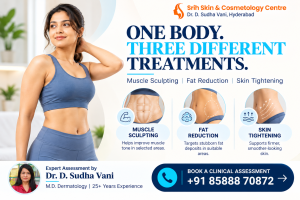
Are you looking to reduce stubborn belly fat, improve abdominal definition, tighten loose skin or achieve a more sculpted body shape without surgery?
When researching non-surgical body contouring in Hyderabad, you may come across treatments such as EMSculpt, EMSculpt Neo, Cryolipolysis, CoolSculpting, HIFU and Quantum RF. Although these technologies are often advertised under the broad category of body sculpting, they do not all target the same tissue or produce the same type of result.
The most important question is not which machine is the best. It is which anatomical layer needs to be addressed.
For example:
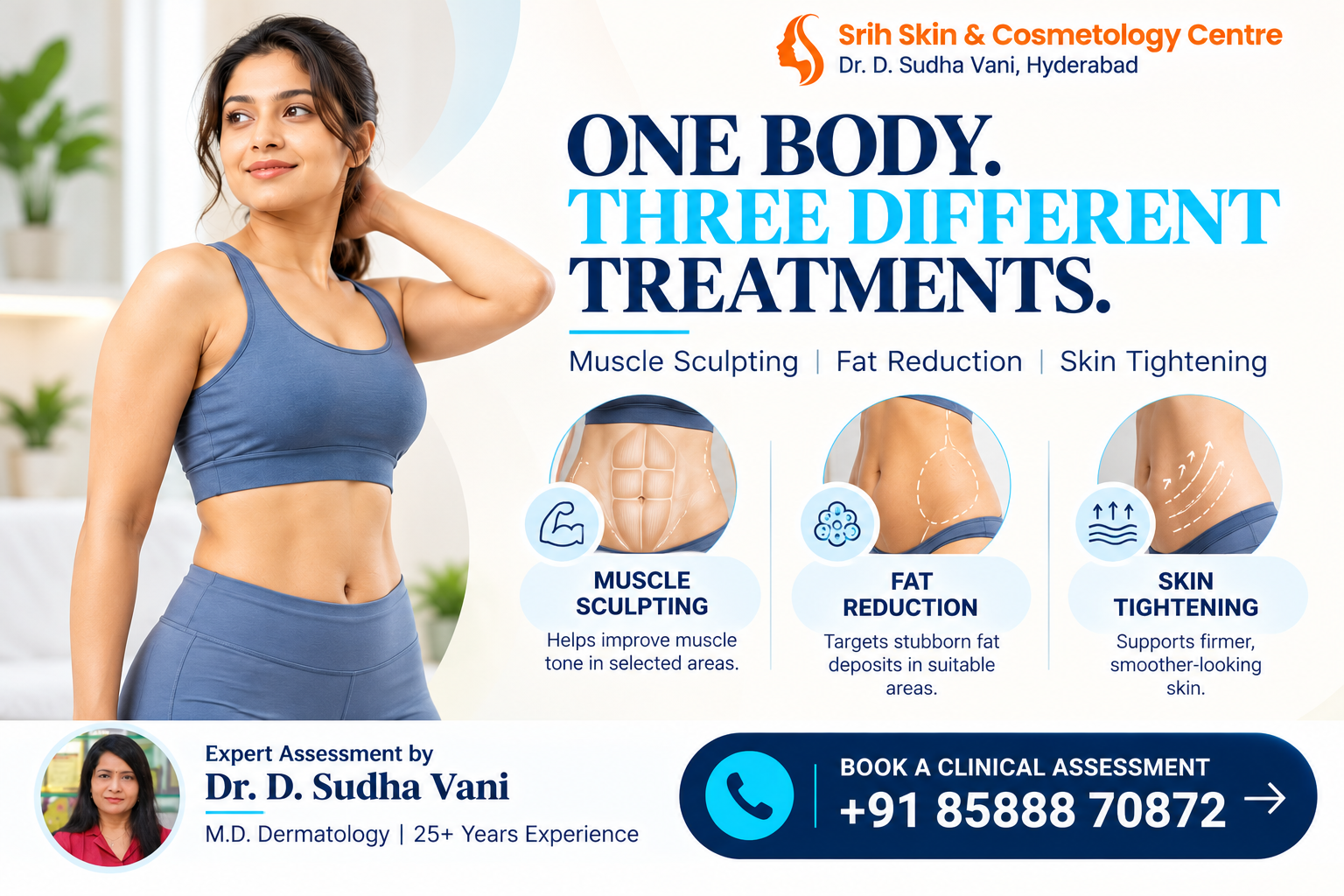
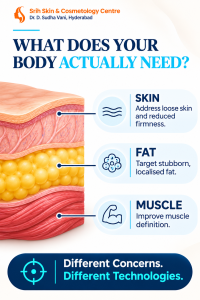
Muscle: Reduced muscle definition may require a muscle-stimulation approach.
Fat: Localised, pinchable fat deposits may be assessed for fat-reduction treatments such as cryolipolysis.
Skin: Loose or sagging skin may require an appropriate skin-tightening approach involving ultrasound or radiofrequency technology.
At Srih Skin & Cosmetology Centre, Dr. D. Sudha Vani, M.D. Dermatology, brings over 25 years of clinical experience to dermatology and aesthetic care. A personalised assessment can help identify the primary concern and determine whether a non-surgical treatment is appropriate.
What you should understand before choosing a body-contouring procedure:
Target layers: Muscle, subcutaneous fat and skin are different anatomical structures.
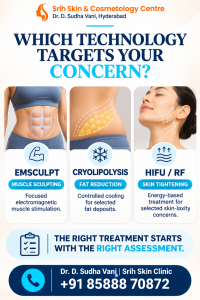
Technology differences: EMSculpt, cryolipolysis, HIFU and RF work through different energy mechanisms.
Individual suitability: The right procedure depends on anatomy, medical history and treatment goals.
Non-surgical options: Selected treatments do not require surgical incisions, although they can still involve side effects and recovery considerations.
Not sure whether you need fat reduction, muscle toning or skin tightening?
Book a Clinical Body Composition Assessment with Dr. D. Sudha Vani.
Call: +91 85888 70872
1. Understanding Body Composition: Muscle, Fat and Skin Laxity
One of the most common misunderstandings about body sculpting is assuming that every unwanted body contour is caused by excess fat.
In reality, the appearance of the abdomen, arms, thighs, buttocks and jawline can be influenced by different anatomical structures.
A treatment designed to reduce fat may not improve muscle definition. Similarly, a procedure intended to tighten skin may not remove a substantial fat deposit.
Understanding the three main treatment targets is the first step towards choosing an appropriate procedure.
1. Subcutaneous Fat Layer: When the Concern Is Localised Fat
Subcutaneous fat is the layer of fat located beneath the skin and above deeper structures.
It contributes to the visible contour of areas such as:
Lower abdomen
Love handles and flanks
Inner and outer thighs
Upper arms
Selected areas beneath the chin
Some people have localised fat deposits that remain noticeable despite maintaining a relatively stable weight and healthy lifestyle.
Potential treatment approach: Cryolipolysis
Cryolipolysis uses controlled cooling to target selected subcutaneous fat deposits. The cooling process can damage susceptible fat cells, which are gradually cleared through the body’s natural processes.
It is designed for localised contour improvement rather than overall weight loss.
It does not target visceral fat surrounding internal organs or build muscle.
2. Dermal and Deeper Supporting Tissue: When the Concern Is Loose Skin
Skin firmness depends on several factors, including collagen, elastin, tissue structure and the natural ageing process.
With ageing, significant weight changes or other individual factors, the skin may lose some of its firmness.
Common concerns include:
Loose skin around the abdomen.
Reduced firmness around the upper arms.
Sagging around the lower face and jawline.
Mild skin laxity after weight loss.
Reduced definition around selected body areas.
Potential treatment approach: HIFU and Radiofrequency
High-Intensity Focused Ultrasound (HIFU) delivers focused ultrasound energy to selected tissue depths. Radiofrequency (RF) uses electromagnetic energy to heat targeted tissue.
Depending on the device and treatment indication, these technologies may help improve the appearance of skin firmness.
The two technologies are different and should not be considered interchangeable.
3. Muscular Layer: When the Concern Is Muscle Definition
Muscle definition depends on muscle size, strength, body-fat distribution and individual anatomy.
Someone may have relatively little excess fat but still feel that their abdomen lacks muscular definition.
Similarly, some individuals seek improved muscle definition around the buttocks or other areas.
Potential treatment approach: HIFEM-based muscle stimulation
High-Intensity Focused Electromagnetic (HIFEM) technology is used in certain non-invasive muscle-stimulation systems.
It generates electromagnetic fields that induce strong muscle contractions.
These treatments are intended to stimulate muscle activity and may support improvements in muscle thickness or definition in selected patients.
They do not replace resistance training, and they should not be considered a treatment for obesity or a substitute for rehabilitation of abdominal muscle separation.
Why identifying the correct layer matters
Consider three different patients:
A person with a pinchable lower-abdominal fat deposit may need an assessment for localised fat reduction.
A person with loose abdominal skin after weight loss may need an assessment for skin-tightening options.
A person with relatively little fat but limited abdominal muscle definition may be interested in muscle stimulation.
Recommending the same machine or treatment package to all three would not address their different concerns.
Dr. Sudha Vani’s assessment-led approach focuses on understanding the underlying anatomical concern before discussing possible treatment options.
2. Understanding the Different Body-Sculpting Technologies
1. EMSculpt and EMSculpt Neo: Electromagnetic Muscle Stimulation
EMSculpt is a proprietary aesthetic treatment system associated with high-intensity focused electromagnetic muscle stimulation.
EMSculpt Neo is a specific system that combines HIFEM+ technology with radiofrequency heating.
These branded systems should be distinguished from generic electromagnetic muscle-stimulation equipment.
How does EMSculpt work?
HIFEM-based technology generates electromagnetic fields that induce repeated, intense muscle contractions.
The contractions stimulate muscle activity beyond what is typically achieved during ordinary voluntary contractions.
Depending on the system and treatment protocol, the intended aesthetic goals may include:
Supporting abdominal muscle definition.
Improving the appearance of selected muscle groups.
Supporting buttock muscle conditioning.
Enhancing the appearance of muscular tone.
What is EMSculpt Neo?
EMSculpt Neo combines electromagnetic muscle stimulation with radiofrequency energy.
The two energy modalities have different purposes:
HIFEM+: Stimulates strong muscle contractions.
Radiofrequency: Produces controlled heating in targeted tissue and is intended to address an additional fat-related treatment component.
This does not mean that every electromagnetic muscle-stimulation device also reduces fat. The exact system and its approved or intended indications should be verified.
Who may be suitable?
Potential candidates may include:
Adults near a relatively stable body weight.
Individuals interested in abdominal muscle definition.
People seeking non-invasive muscle stimulation.
Selected individuals interested in improving the appearance of specific muscle groups.
A clinical assessment is important before treatment.
What EMSculpt cannot do
EMSculpt should not be presented as a replacement for exercise, a comprehensive weight-management programme or surgical treatment.
It is also important to distinguish cosmetic muscle stimulation from treatment of medical conditions such as diastasis recti. Postpartum abdominal separation requires an appropriate clinical assessment and may need specific rehabilitation rather than an aesthetic device procedure.
Important: EMSculpt and EMSculpt Neo are branded systems. Their availability at Srih Skin Clinic should be confirmed before describing them as clinic services.
2. Cryolipolysis and CoolSculpting: Controlled Fat Freezing
Cryolipolysis is a non-surgical body-contouring technique that uses controlled cooling to target selected subcutaneous fat deposits.
CoolSculpting is a proprietary brand associated with cryolipolysis technology.
The two terms are related, but they are not interchangeable.
How does cryolipolysis work?
The procedure uses an appropriate applicator to deliver controlled cooling to a selected fat deposit.
The cooling can damage susceptible fat cells, which are gradually processed and removed by the body’s natural mechanisms over subsequent weeks and months.
Different devices use different applicator designs, cooling parameters and treatment protocols. Therefore, a single temperature should not be assumed to apply to every cryolipolysis system.
Primary treatment goals
Cryolipolysis may be considered for selected areas such as:
Abdomen and lower belly.
Flanks and love handles.
Selected thigh fat deposits.
Other suitable areas of localised subcutaneous fat, depending on the device.
Who may be suitable?
Adults with relatively stable body weight.
Individuals with pinchable, localised fat deposits.
People seeking modest contour improvement.
Individuals who understand that results develop gradually.
What cryolipolysis cannot do
Cryolipolysis is not a general weight-loss treatment.
It does not:
Build or strengthen muscle.
Treat visceral fat.
Reliably tighten significant loose skin.
Replace surgical fat removal when substantial reduction is required.
Possible side effects include temporary redness, swelling, bruising, tenderness and numbness. Less common complications include paradoxical adipose hyperplasia, in which the treated area enlarges rather than becoming smaller.
For more information, read about non-invasive body sculpting and cryolipolysis.
3. HIFU and Quantum Radiofrequency: Skin Tightening Technologies
When the main concern is sagging or reduced skin firmness, a fat-freezing procedure may not address the underlying problem.
HIFU and RF are energy-based technologies that may be considered for selected skin-tightening indications.
How does HIFU work?
High-Intensity Focused Ultrasound delivers focused ultrasound energy to selected tissue depths.
The energy produces controlled thermal effects at the focal points. Depending on the device and treatment indication, this may stimulate tissue remodelling and collagen-related responses.
Potential aesthetic treatment goals include:
Improving the appearance of mild skin laxity.
Supporting lower-face and jawline definition.
Addressing selected double-chin concerns.
Improving the appearance of skin firmness in suitable treatment areas.
The actual treatment depth depends on the transducer, device specifications and individual anatomy.
How does radiofrequency work?
Radiofrequency uses electromagnetic energy to generate heat within targeted tissue.
Depending on the technology, RF may be used for selected skin-firmness and body-contouring indications.
Some systems combine RF with other energy modalities, while others use RF independently.
What is Quantum RF?
The term Quantum RF may refer to a specific branded system or a particular radiofrequency treatment platform. Its exact mechanism, treatment indications and specifications should be verified against the manufacturer’s documentation.
It should not automatically be treated as synonymous with all radiofrequency procedures.
Before choosing a Quantum RF treatment, ask:
What is the exact device and manufacturer?
Is it monopolar, bipolar, fractional or another RF configuration?
What treatment indications does the manufacturer specify?
Which tissue depths are targeted?
What are the potential risks and expected outcomes?
Who may be suitable for HIFU or RF?
Potential candidates may include individuals with:
Mild to moderate skin laxity, depending on the device.
Reduced skin firmness.
Selected lower-face or jawline concerns.
Skin laxity in suitable body areas.
Neither HIFU nor RF guarantees a particular degree of lifting or fat reduction. Significant excess skin may require a different treatment approach.
For further details, explore HIFU treatment in Hyderabad.
3. EMSculpt vs. Cryolipolysis vs. HIFU / RF: Comparison Matrix
The following comparison explains the primary differences between the technologies.